

What if your classroom could talk back, breathe, and even simulate heart and lung abnormalities?
That’s exactly what second-year Doctor of Physical Therapy (DPT) – Residential program student Emily Collins experienced at the Medical University of South Carolina’s (MUSC) state-of-the-art Healthcare Simulation (SIM) Center. Reflecting on her experience, Emily shares how the simulation-based learning environment helped her connect classroom concepts to real-world patient scenarios, build clinical confidence, and practice hands-on skills in a safe, supportive setting—preparing her for success in upcoming clinical rotations.
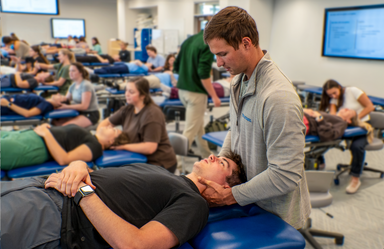
As a second-year MUSC DPT student, I had the amazing opportunity to learn and practice cardiopulmonary diagnostic assessments and interventions in MUSC’s world-class Healthcare Simulation Center. This experience allowed us to practice our hands-on lab skills in an environment simulating real patient cases, allowing us to apply clinical meaning and relevance to these skills.
We had the opportunity to translate what we learned in class into real-world practice by identifying normal and abnormal lung sounds. We listened to these sounds on medical mannequins and practiced the different placement of our stethoscopes for auscultation. We took turns playing sounds for one another to listen to and determine which sound it was. This environment allowed us to learn from our mistakes in a safe way before working with real, live patients.
We also had the opportunity to work with patient mannequins in hospital beds, which was another great way to simulate the new feeling of being in a hospital room and how to handle the equipment and maneuver around everything. We practiced reading vitals and electrocardiograms (EKGs) with the help of our professors. We were also able to practice postural drainage (a technique that uses gravity and body positioning to help drain excess mucus from a patient’s lungs), among other breathing techniques, on these patient simulators. We practiced patient education while performing these techniques and were given feedback from our peers. The medical mannequins simulated heart and breath sounds in addition to pulse and blood pressure. This enabled us to practice hands-on skills as well as use our clinical reasoning to determine the conditions and impairments the patient stimulators were experiencing.
I was grateful to have this environment to learn from, with guidance from our professors. We worked through multiple patient cases, emulating real patient experiences using our clinical reasoning with the use of the medical mannequins. The medical mannequins simulated reactions real patients would have and allowed us to have that “in the moment” training that will help us in future practice. Working in groups with other physical therapy students allowed for great collaboration and clinical reasoning together regarding the cases. These simulations reinforced the importance of collaboration of the health care team for the best patient outcomes.
I also appreciated the time our professors took to debrief and analyze the cases with us, following our own clinical reasoning to ensure we fully understood the cases and correct outcomes. Being able to try multiple approaches on patient simulators in a safe environment allowed all of us to experience constructive failure and learn from it, helping us grow for future clinical practice.
I am grateful to attend a school that provides opportunities like this, allowing me to apply the skills I learn in the lab within a controlled environment where I can build confidence before entering clinical rotations and caring for future patients.
Experiences like these prepare MUSC DPT students to step into patient care with confidence and competence. Are you ready to take your skills from the classroom to real-world practice? Explore our Doctor of Physical Therapy programs and discover how hands-on learning at MUSC will prepare you for your future as a physical therapist:
Recent College of Health Professions stories