
Student story written by: Michael Kirby
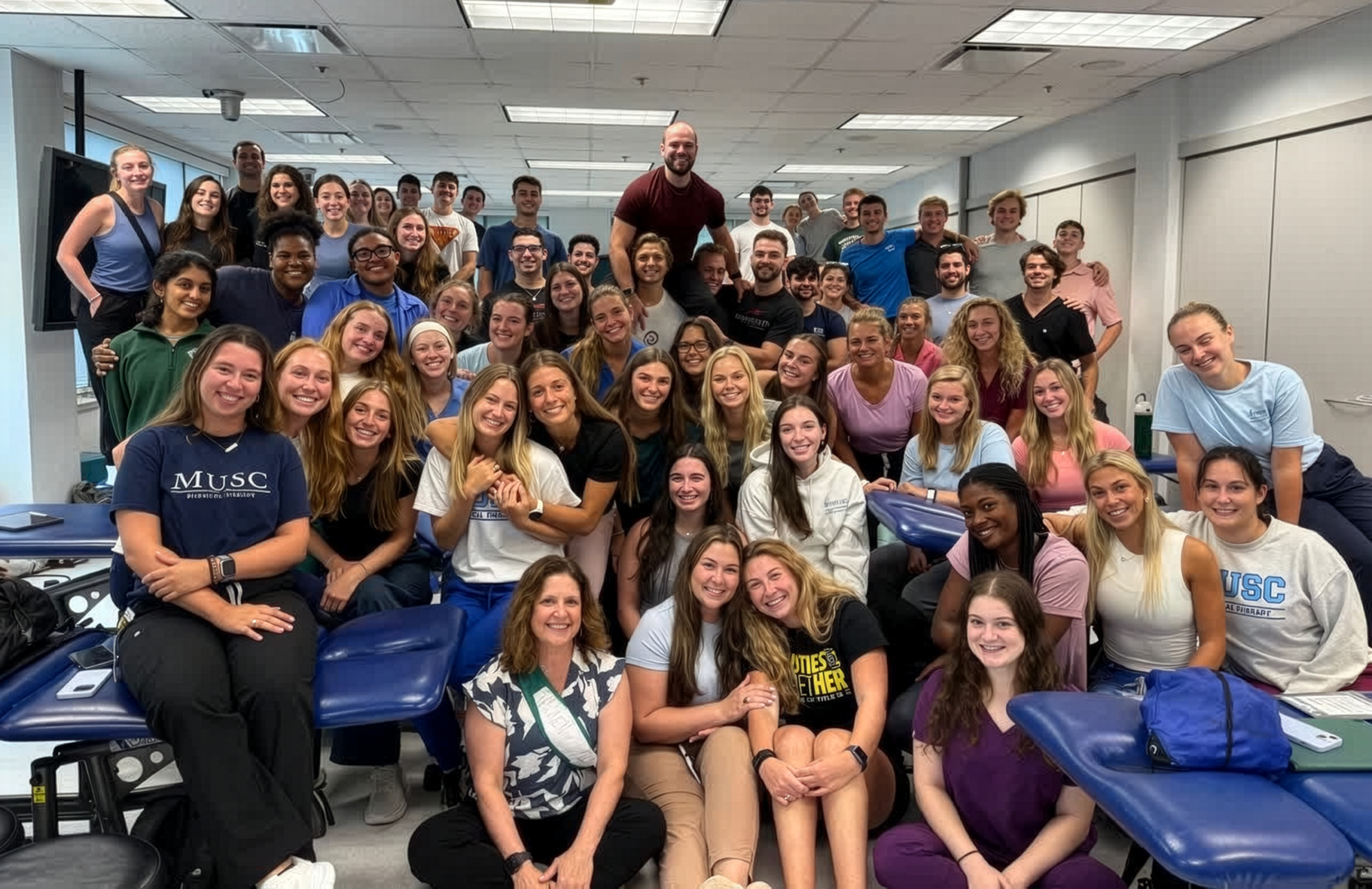
A lot of people are afraid of change, but the transition into the College of Health Professions “D” building (CHP-D) has been refreshing. The new building has a space suited for every type of learning we’re tasked with each day as Doctor of Physical Therapy (DPT) students. Whether it’s a lecture-heavy class, a session that requires tables, or hands-on practice on mats, there’s always a space designed to meet our needs. Each area is fully equipped with the tools we might use (including weights, yoga balls, wheelchairs, and walkers), and storage is conveniently located throughout the building, making it easy to access equipment whenever we need it.
One of the most noticeable enhancements is in the classrooms. For many students, following along with slides can be a challenge, but now each classroom is equipped with large monitors and speakers that allow everyone to keep pace with the lecture. When you are surrounded by the material and the professor can circulate the room while teaching, it creates an environment that invites deeper learning. My engagement has never been higher, and I am more eager than ever to learn new content each day.
Access to lab spaces that can accommodate our entire cohort has also made a big difference. I can now practice with every classmate, gaining exposure to a wider variety of patient scenarios. As my classmate Cailey Haas shared, “Having our entire cohort all in one open lab space allows us to practice on each other while our professors walk around giving real-time, one-on-one feedback. The space feels collaborative, efficient, and designed to truly prepare us to step confidently into clinical experiences and our future as physical therapists.”
We frequently invite patients into CHP-D for immersive learning experiences, and the large space allows us to use whatever tools we need, depending on the patient’s presentation. I’ve never felt more confident engaging with patients, and the excitement for my future as a clinician continues to grow. Having other rehab sciences programs (occupational therapy and speech-language pathology) in the same building also opens the door for interprofessional collaboration that will enhance patient outcomes in the years ahead.
Giving tours of CHP-D to prospective students has offered me a unique perspective on the building’s impact. It’s clear that the university designed these spaces with students in mind, demonstrating a genuine investment in our success. I feel valued learning here each week, and it reinforces that the profession I chose has meaning in our community. As my classmate, Mallory Hobday noted, “With the new CHP-D building, I’ve had the opportunity to learn in a space that has been tailored specifically to the demands of our active, hands-on profession. For example, in our Neuromuscular class this semester, our professor, Dr. Sara Kraft, lectures for part of the class then seamlessly transitions to lab to demonstrate these skills. Having immediate hands-on practice while learning the material is incredibly beneficial.”
I feel valued being able to learn in this space each week! For MUSC rehab science students, CHP-D has created a space that not only works for us but also truly feels like it was built for us.
Curious to see how learning in MUSC’s CHP-D building can shape your journey as a Doctor of Physical Therapy (DPT) student? Schedule a guided campus tour today to experience hands-on learning firsthand.
Step inside CHP-D with us!
Recent College of Health Professions stories