

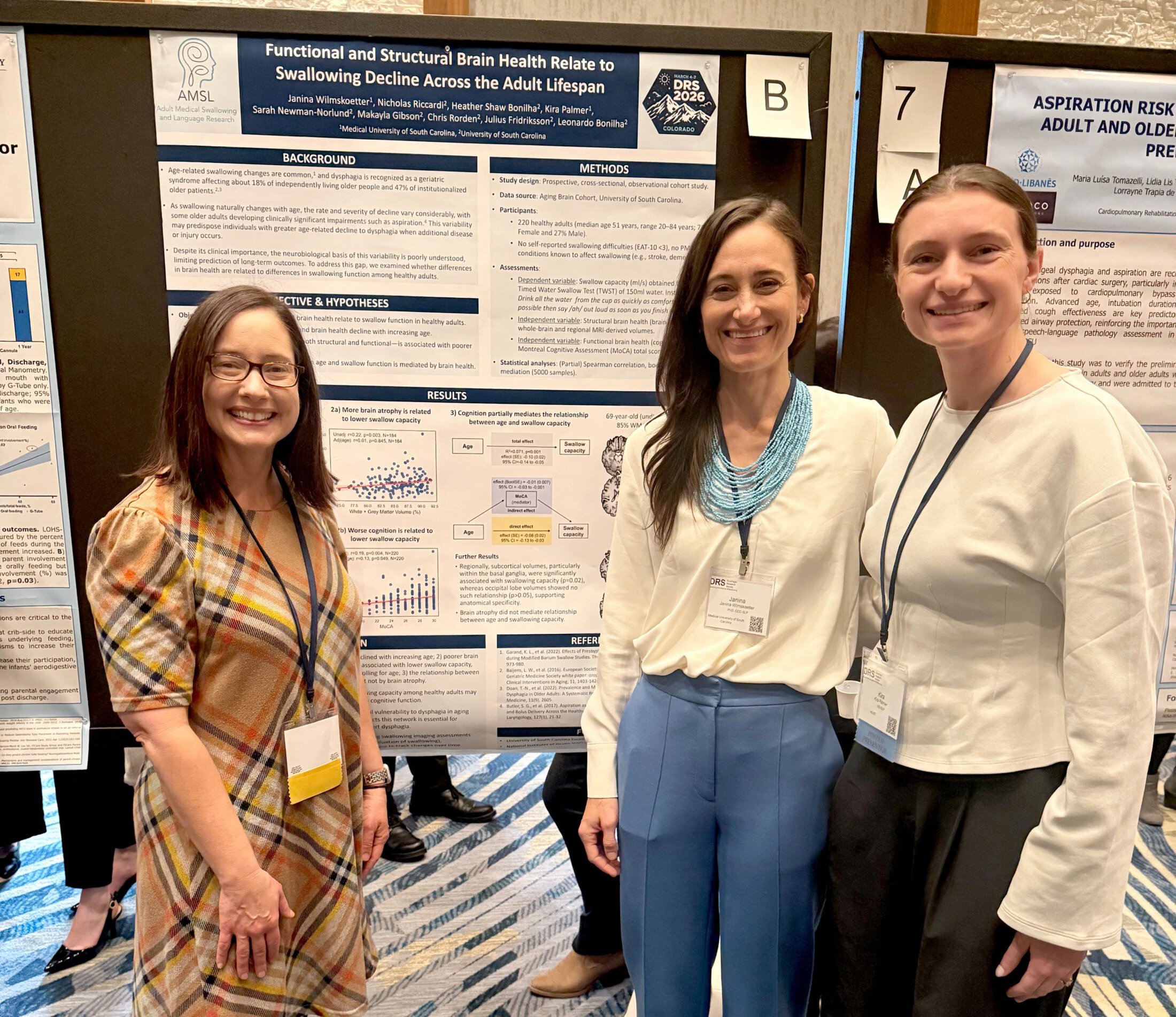
Heather Bonilha, Janina Wilmskoetter, and Kira Palmer presenting the poster "Functional and Structural Brain Health Relate to Swallowing Decline Across the Adult Lifespan.” This work explored how brain health metrics relate to swallowing changes over time, contributing to a growing body of research on aging, neurobiology, and dysphagia.
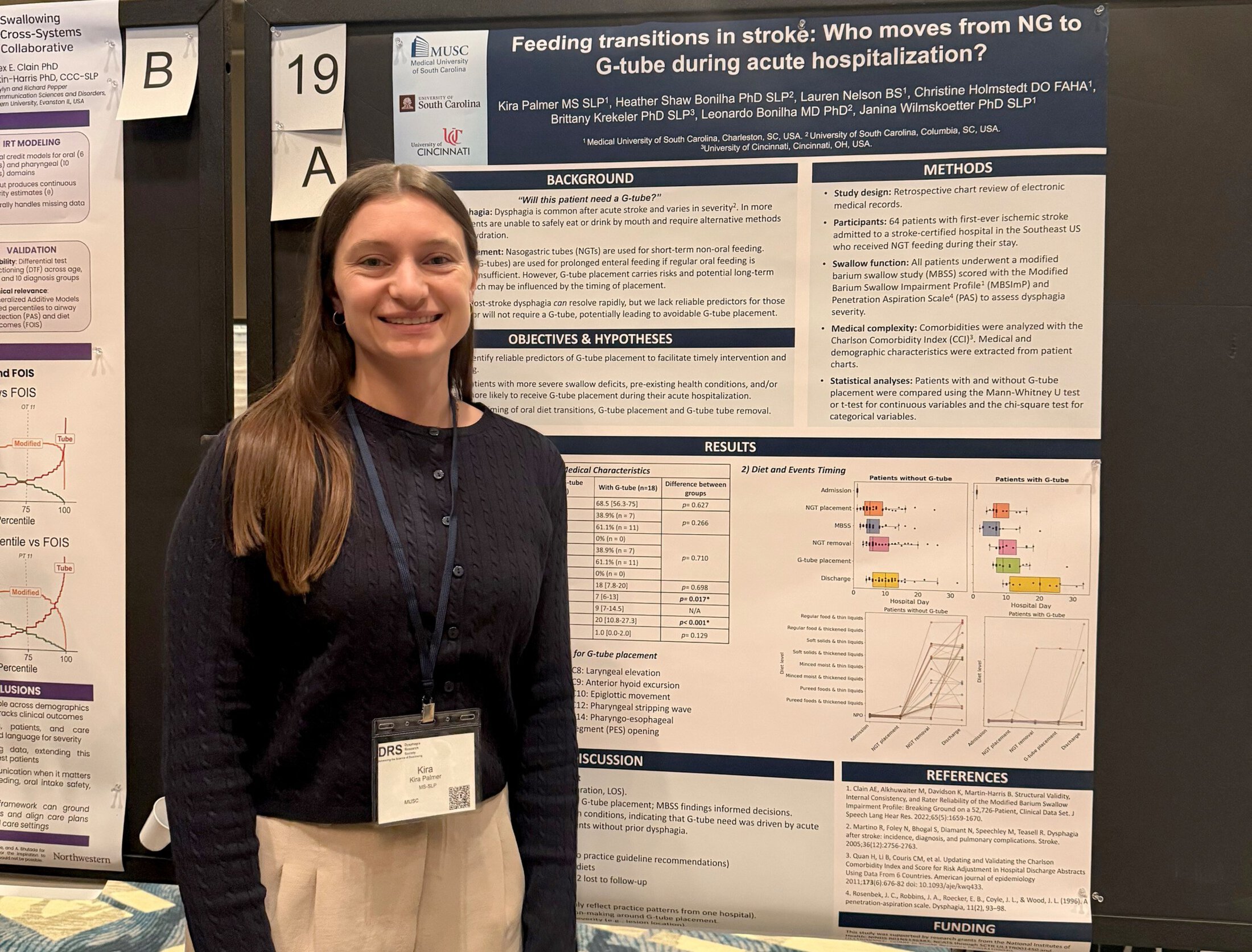
Kira Palmer stands in front of a research poster at the 2026 Dysphagia Research Society (DRS) Annual Conference.
AMSL Lab Showcases Award-Winning Research at the 2026 Dysphagia Research Society Meeting
Members of the AMSL Lab attended and presented at the 35th Annual Dysphagia Research Society (DRS) Meeting, held March 4–7, 2026, in Aurora, Colorado. The DRS Annual Meeting brings together international researchers and clinicians to advance the science of swallowing across the lifespan, making it a key venue for sharing innovative and interdisciplinary dysphagia research.This year’s meeting was especially meaningful for the AMSL Lab, with multiple presentations highlighting ongoing work in stroke, brain health, and swallowing function.
Award-Winning Oral Presentation
Janina Wilmskoetter, Ph.D., delivered an oral presentation titled “Lesion-based neural network mapping of post-stroke dysphagia.” Her talk was recognized with second place for Best Oral Presentation, an honor that reflects both the scientific rigor and clinical relevance of this work. The presentation explored how lesion-based neural network mapping can deepen understanding of post-stroke dysphagia mechanisms and inform future assessment and treatment approaches.Poster Presentations
The AMSL Lab also contributed two poster presentations that sparked engaging discussion throughout the conference:Kira Palmer et al. presented “Feeding Transitions in Stroke: Who Moves from NG to G-Tube During Acute Hospitalization?” This poster examined patterns and predictors of feeding tube transitions in acute stroke care, with implications for clinical decision-making and patient outcomes.
Janina Wilmskoetter et al. presented “Functional and Structural Brain Health Relate to Swallowing Decline Across the Adult Lifespan.” This work explored how brain health metrics relate to swallowing changes over time, contributing to a growing body of research on aging, neurobiology, and dysphagia.
Looking Ahead
Participation in the 2026 DRS meeting highlights the AMSL Lab’s ongoing commitment to advancing dysphagia research through collaborative, translational science. We are proud of our team members for their outstanding contributions and look forward to building on these findings in future work.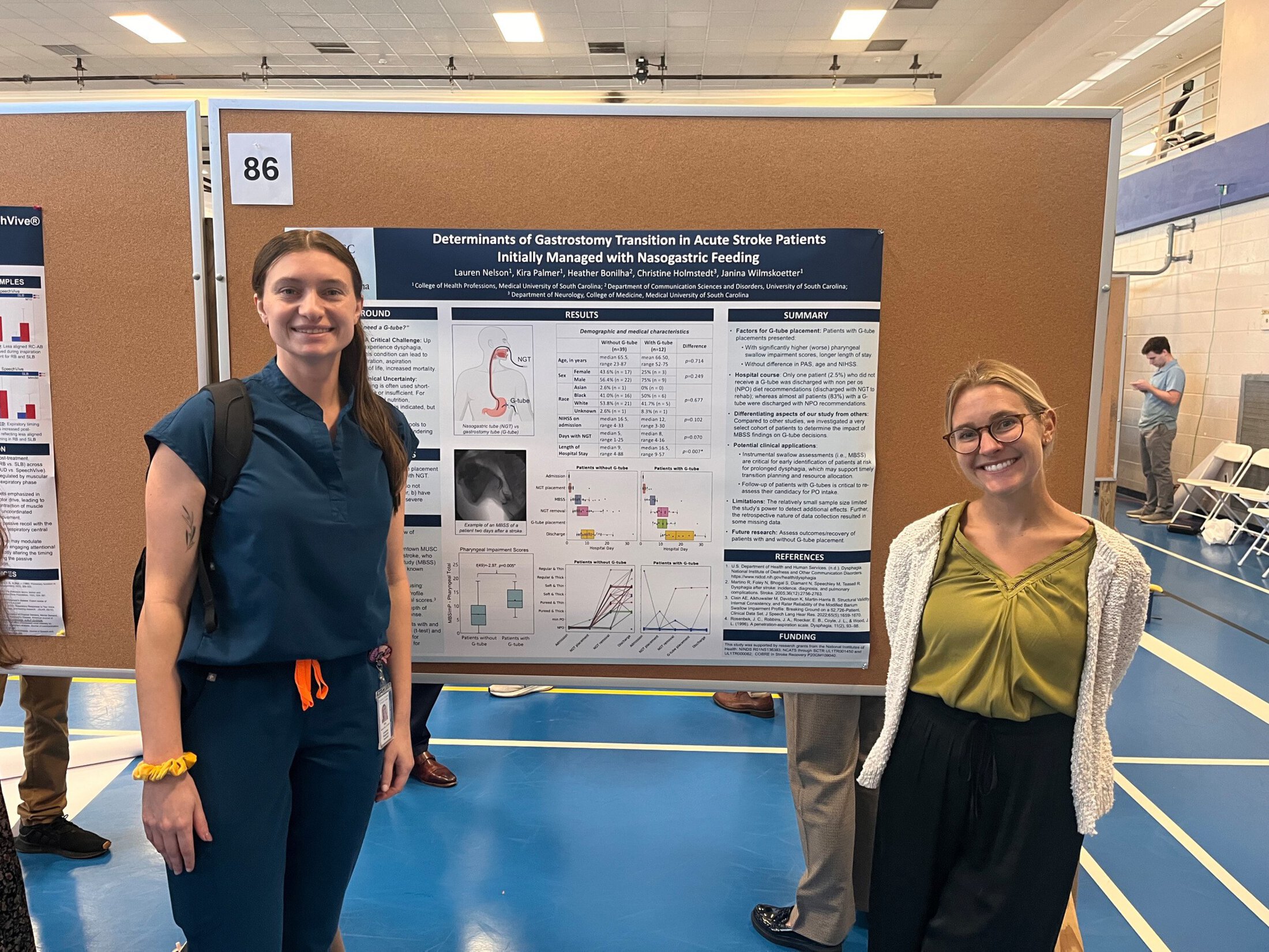
Kira Palmer (Speech Language Pathologist, Doctoral Student) and Lauren Nelson (Master's Student Speech Language Pathology) presented their AMSL lab research at the MUSC research day in November 2025.
MUSC Research Day Success
We are proud to celebrate our student research assistant, Lauren Nelson, who earned 1st Place for her poster presentation in the Undergraduate/Master’s category at the MUSC Research Day 2025 (November 7, 2025). This is an outstanding accomplishment, as Lauren competed among students representing all MUSC colleges.We also recognize the mentorship of our Ph.D. student, Kira Palmer, whose guidance and support were instrumental in preparing Lauren’s award-winning poster.
Recent College of Health Professions stories
College of Health Professions + Division of Physical Therapy
Is a DPT Worth the Investment? Understanding the Cost and Value of a Doctor of Physical Therapy
College of Health Professions + Division of Bachelor of Science in Applied Health Intelligence and Administration
Applying AI and analytics to healthcare management
College of Health Professions + Division of Master of Science in Healthcare Quality and Safety
Fixing Things No One Asked Them to Fix: Why a Master’s in Healthcare Quality and Safety is Vital...