
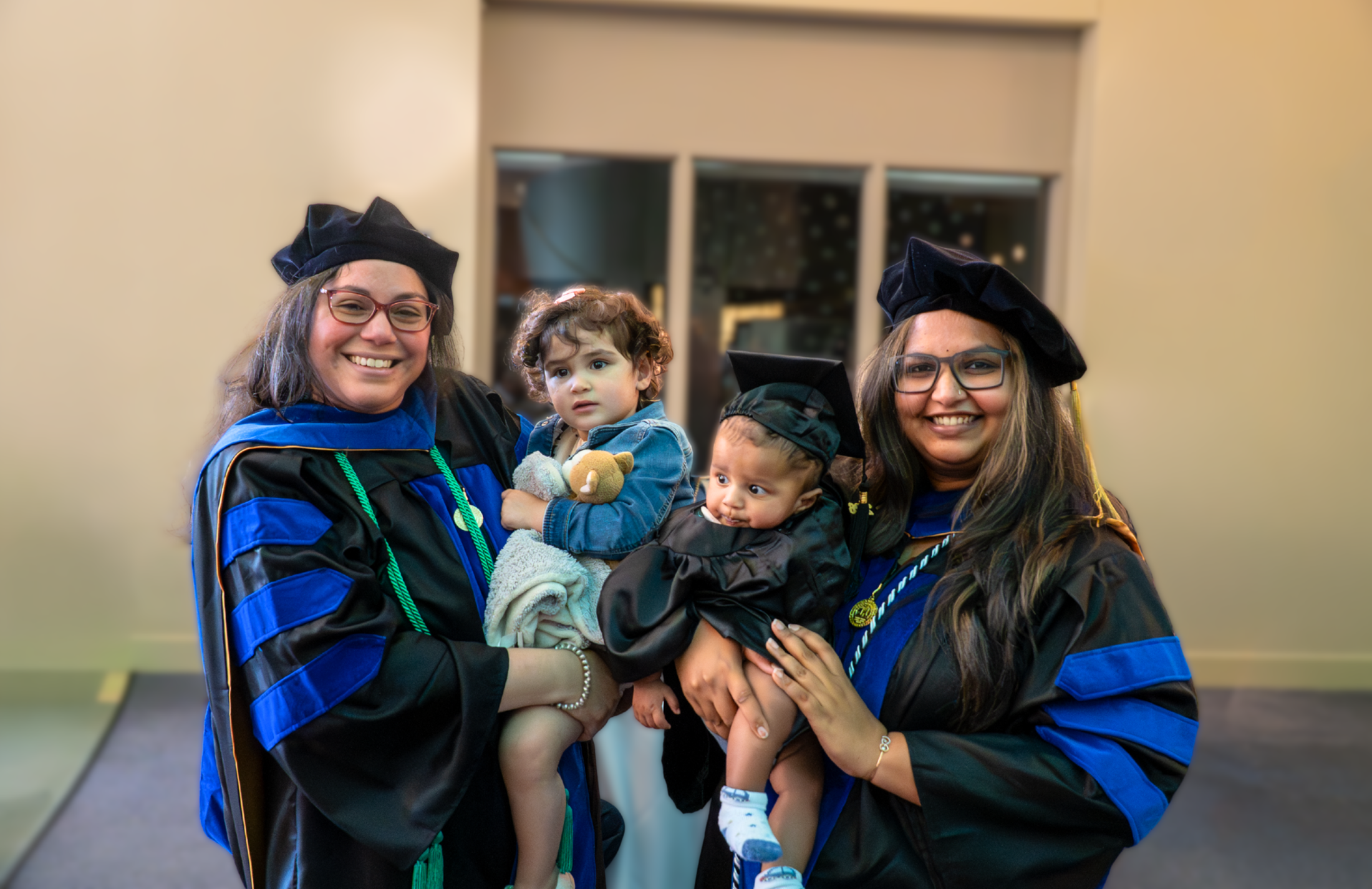
For two recent graduates of MUSC’s Ph.D. in Health and Rehabilitation Science program, the final stretch of doctoral training unfolded alongside a life-changing milestone: becoming a mother.
For Pooja Pradeep, whose research examines how mid-life obesity influences Alzheimer’s disease progression, motherhood came during the final phase of her Ph.D., as she worked to complete experiments and write her dissertation. She defended her work when her son, Veer, was just 3.5 months old.
“It was a mix of joy, exhaustion, and constant adjustment,” she said. “I was learning to care for a newborn while trying to complete my work.”
Lizmarie Maldonado, whose research focuses on mental health trends among pregnant women before and after major disruptions such as the COVID-19 pandemic, had her daughter, Marisol, just before her final semester of coursework and comprehensive exams. The transition brought long days, shifting schedules, and the challenge of balancing academic milestones with the demands of early caregiving.
“I got through the program the same way I navigated motherhood: one day at a time,” she said.
Prioritizing each day’s most critical tasks, Pradeep learned to work in short, focused blocks when possible, while Maldonado broke responsibilities into smaller, manageable steps while navigating childcare arrangements.
For both researchers, the challenges were not only logistical but also deeply personal as they adapted to the emotional weight that often accompanies early motherhood. Balancing postpartum recovery with academic expectations required flexibility, as both learned to adjust and redefine what progress looked like. Having a professional network that cared about them personally was also key.
Throughout their journeys, both point to the support systems that made degree completion possible. Pradeep credits her mentor, DeAnna Baker Frost, MD, Ph.D., who stepped in during critical research periods and milestones to cheer her on and keep her on track. Maldonado recalls similar flexibility from faculty and steady encouragement from peers—many of whom are also parents—and a baby shower organized by classmates shortly before her daughter’s birth.
Moments like these underscored the inclusiveness of the MUSC community that surrounded them. For both graduates, mentorship, family support, and peer connection became steady anchors through uncertainty and change.
Motherhood also reshaped how they approach their work. Pradeep describes a renewed sense of purpose and sharper focus on priorities, while Maldonado notes a deeper appreciation for research that addresses maternal mental health and the perinatal experience.
“There is no straight line to a Ph.D.,” Maldonado said. “You adapt, adjust, and keep moving forward.”
Now graduated, both leave with more than a doctorate—carrying forward lessons in resilience, perspective, and community that extend well beyond the lab.
Learn more about the Ph.D. in Health and Rehabilitation Science.
Katie Ennis
Recent College of Health Professions stories